
Scaling up or not scaling up

Is this the end of the ‘knowledge worker’ era?

Hervé Rolland offers business coaching services to CEOs of organisations and strategy advisory services to SMEs.

Control, Influence, Empowerment

The importance of the relation between performance, culture and oneself

Hervé Rolland – Business Coach | Business Mentor | Strategy Partner

What is the secret behind growing a business?


Besides all the known ways of growing a business like growing geographically, or by creating a new market space through innovation, or by changing the rules of how an industry is structured, or by acquisition to name just a few, at its core, there must one fundamental:

A clearly articulated, well communicated and well executed strategy.

Why? Because having a clearly defined strategy will give direction to the whole organisation. It will gather employees and stakeholders around a common objective. It will get all departments aligned to build and deliver on that value proposition that will attract more customers and give them a clear reason why they choose to buy your product. A well communicated strategy will give clarity. A clear set of choices including capabilities to build as well as management systems to serve the where-to-play and how-to-win choices, all feeding back to the winning aspiration of the organisation.

If the leaders of organisations make sure everyone is aware of the strategy, its why, its direction and that everyone plays a part in bringing the strategic choices to life, they will not only increase the odds of winning but also reach meaningful growth and create momentum in their business. And that is really powerful.

Hervé Rolland

Business Coach | Business Growth Specialist | Business Mentor | Strategy Consultant

Share on LinkedIn by clicking on icon below

What is the biggest cause of strategy failure?

You might have come across the following quote attributed to Morris Chang – the founder of Taiwan Semiconductor Manufacturing Company – “Without strategy, execution is aimless. Without execution, strategy is pointless.”

One of the main reasons a strategy fails in its execution is that it is not something you do alone! A classic approach in SMEs (of a certain size) is for the CEO to fabricate alone (or with a very small number of the leadership team) a strategy and push it forcefully through the whole organisation. This approach tends to create many hurdles and resistance from staff and key influencers (managers and team leaders) within the company which will threaten the success of implementing the strategy.

What to do?

Involving a diverse group of people from the organisation and at different leadership level is a good start. Bringing in an external ‘strategy facilitator’ who will neutrally conduct the discussions using a clear & proven methodology is another good step. That will guaranty some neutrality and will get everyone to embrace the logic and reasoning behind each key choice that will be made within the strategy. It will dramatically increase the chances of success of its implementation. Imagine the power of having key influential people within the organisation fully behind the strategy and each choice made! This will unleash action and momentum.

Thanks for reading.

Hervé Rolland – business coach – business mentor – strategy partner of SMEs

I care about Business

connect with Hervé on LinkedIn

Creating a high performance culture

Here is a topic that many leaders would love to have the recipe for and achieve the greatest performance for their business. The reality is complex and many factors contribute to the level of people’s performance in a business.


In simple terms, we can define performance as the best one can do in a competitive environment. This means performance in relation to others and or in relation to some key measures of performance criteria. In organisations, performance is usually measured against the desired results and KPIs set out by the leadership.


There are 3 levels of performance in businesses: the individual level, the team level, the whole organisation level (or the whole division, or business unit).
When thinking of creating a highly performing organisation, one must think about those three levels and how they can influence each of them to create the conditions of high performance. A vast task.

The best way to look at this is to first consider what is actually affecting performance under each level.

Under the individual level, performance can be affected by personal reasons and work related reasons. The best an Organisation can do at an individual level is to make sure the individual is supported throughout her or his career within the company. There has to be a sense of progress and support throughout for each individual. Key values of respect, self esteem building, promotion possibilities, fair compensation, pleasant working environment, trust and more must be lived throughout the leadership. Any deviance from those should be addressed immediately. One key question for a leader when identifying a potential issue is to ask themselves: ‘is it an isolated individual incident or is this a pattern?’ It is clear that the leadership here sets the tone for a culture of high performance.

On a team level, performance takes a new dimension that requires subtle skills from the leadership to put people with different skills and personalities together to achieve a common goal. This is not an easy task especially when a leader has inherited a dysfunctional team following a promotion or has been recruited from outside of the organisation. A leader must be a good personality traits and skills reader to compose an effective team.

On the organisation level, performance will be affected by the lack of direction, the lack of clear goals, the lack of purpose of why we do what we do, by the quality of the leadership itself, and for business owners directly by the way they handle their leadership.

Creating a highly performing culture within a business takes a lot of thoughts and a careful approach. Addressing the question of what affects the performance of the organisation on those 3 levels is a good place to start.

Herve Rolland.
Business Coach

Leadership & Power

Leadership in organisations is a privilege that gives leaders certain powers and a chance to influence others. Personality traits play a big part in the kind of leader you will become.

We all know the expression ‘power corrupts’, especially when people in power stay there for too long. There are many examples around the world of politics. It is quite similar in organisational leadership for leaders who have gained a few years of experience. Becoming a leader always carries such a risk of feeling tempted consciously or unconsciously to control and manipulate team members and consequently create a more toxic environment. This leadership position will undoubtedly expose the leader very transparently whether he or she likes it or not and whether he or she wants to show their true self or hide it or even act as someone else. All the leader’s character traits will be greatly exposed and the people they lead will very quickly get an idea of what kind of leader they are. That is why getting feedback is very valuable to one keep the leader in check and two, to learn about themselves so that they can become a better leader by adjusting their style based on the feedback received. It is also very important for the organisation to create a culture that will make sure its leaders are kept in check by having this feedback transparency.

For instance, if you have a propensity to get easily angry, to control, to be unpleasant, lazy, manipulative, or brave, courageous, a team player, a visionary, a supportive type, the people you lead will very quickly be able to let you know in many ways. That is if you create a feedback culture so that you, leader, understand how you are perceived.

Leadership might grant you more power and influence, but it will also expose the true you. Having the courage to create a culture of ‘honest’ feedback brings great benefits to the leader and the organisation. They will learn a lot more about themselves which in return will help them become a better leader. It will also avoid the mind corruption that can be so counter productive in the organisation.

Building Resilience in your Business

Building resilience for us humans is as much about working on the psychological than the physical part of ourselves. In other words, it means building resilience within the mind and within the body. The two cannot be dissociated. They are part of our whole.

In business, building resilience revolves around two aspects.

The first one is building the resilience of every employee by helping them build and develop their self-esteem. There is a duty of care on the part of the employer towards the employees. Building resilience within its employees should be a focus for management and the leadership. Too often the employee is seen as a fixed asset rather than a continuously evolving person interacting with his or her environment.

The second one is building robust processes and plans to deal with adverse external forces. Forces that can be competitive forces, environmental forces, legislation changes, even internal forces.

Ultimately, building resilience in a business comes down to creating, encouraging and developing resilience and agility in the mind of your employees and in the body of the business itself ( its processes and plans).

Build your business resilience

Hervé Rolland – Business & Leadership Coach

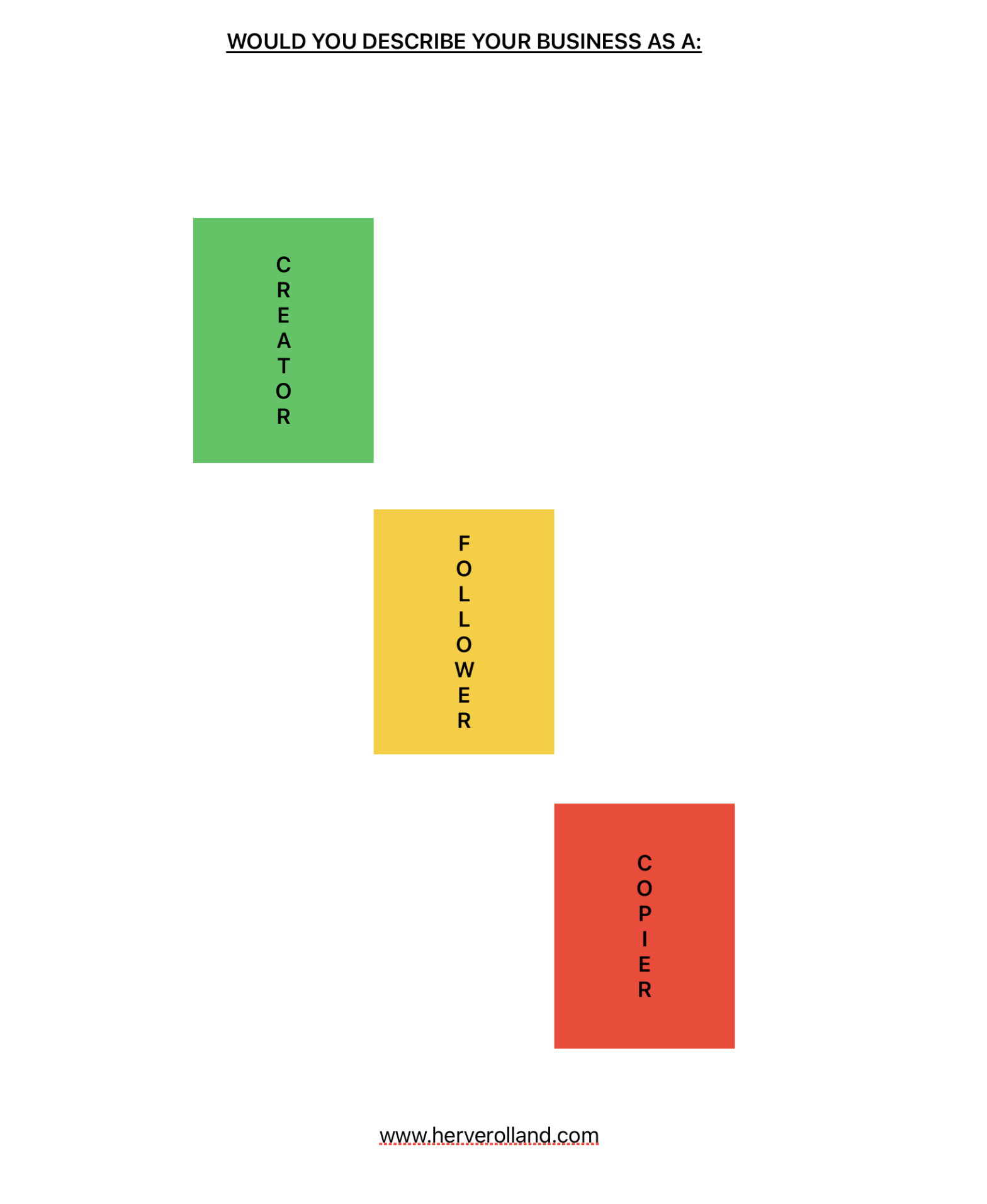
Creator, Follower or Copier?

The Creator

If you are a creator, you are a true innovator.

Being a creator means:

  • Leading the way……positioning your business as a leader
  • Inspiring others to follow
  • More innovative
  • Higher margins
  • Greater impact on the wider environment – can make a real positive change
  • Less competition
  • High value creation
  • Higher investment
  • Creates more jobs

The Follower

If you are a follower, it means:

  • Following in the footsteps of a creator (can be a fine strategy)
  • Good enough margins
  • Some innovation but less than the creator
  • More competition but can still do quite well
  • A bit more pressure on prices
  • A multiplication effect and impact on the environment depending on who they are following
  • Good value creation
  • Creates some jobs too

The Copier

If you are a copier, well you just:

  • Only copy others
  • Low margins
  • Lots of competitors
  • No creativity
  • High pressure work
  • Barely creates jobs
  • Low value creation
  • No innovation
  • Poor or lower quality products or services
  • Often a detrimental impact on the environment

Where would you like your business to position itself? More as a creator, or more as a follower, or more as a copier?

What about a country? What should a country encourage to create meaningful and impactful growth? A great question to start thinking strategically about the direction of a country or a business.

Hervé Rolland – Business & Leadership Coach with a global perspective